
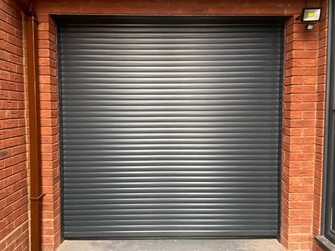
A well-specified roller garage door is one of the most secure options on the UK market, but only when it’s built and locked properly. Double-skinned aluminium construction, automatic self-locking and police-accredited certification all make a real difference; a basic single-skin steel roller doesn’t offer the same protection.
This article covers how roller garage doors are built and locked, which UK security standards actually mean something, how they compare with sectional and up-and-over doors, the break-in methods they need to resist, and what we, from years of supplying and installing these doors, would recommend if security is your priority.
- 1 What Actually Makes a Roller Door Secure
- 2 Why the Best Roller Garage Doors Have No External Lock
- 3 Roller vs Sectional vs Up-and-Over Garage Doors: How Do They Compare on Security?
- 4 How Break-Ins on Roller Garage Doors Actually Happen
- 5 Smart Roller Doors and Remote Security
- 6 Improving an Existing Roller Door’s Security
- 7 Conclusion
What Actually Makes a Roller Door Secure
Roller garage door security comes down to two things: the strength of the curtain (the rolling section of horizontal laths, or slats) and how it locks.
- Double-skinned aluminium laths, typically around 77mm deep with a CFC-free polyurethane foam core, give the curtain rigidity and resistance to being levered or punched through.
- Single-skin steel roller shutters are lighter and cheaper, but much easier to force. In our experience specifying doors for UK homes, this is the single biggest decision that separates a genuinely secure door from one that only looks the part.
- Reinforced end plates and a steel bottom lath add strength at the points most likely to be attacked.
- Deep guide channels (90mm on premium ranges) make it harder to lever the curtain out of its track.
Why the Best Roller Garage Doors Have No External Lock
Quality automatic roller garage doors lock themselves every time they close, either through anti-lift straps that engage as the curtain reaches the floor, or a self-locking gearbox motor that holds the curtain shut. There’s often no external lock cylinder at all, which means break-in attempts using picking, drilling and snapping simply have nothing to work on.
Hörmann describes this directly for its RollMatic range, stating the shaft profile makes it “practically impossible to push the curtain open.” SWS UK’s SeceuroGlide Excel goes a step further with a patented locking bottom slat that stops the curtain being pushed out of its guides.
Manual roller doors rely instead on a spring-assisted mechanism and a separate lock. From our experience on site, this is the real trade-off between manual and automatic doors: manual depends on the quality of a conventional lock, automatic depends on the motor holding firm and the emergency release being properly protected (more on that below).
Roller vs Sectional vs Up-and-Over Garage Doors: How Do They Compare on Security?
No garage door type is inherently insecure, but each one achieves security in a different way.
| Door type | How it locks | Typical weak point if poorly specified |
|---|---|---|
| Roller | Auto-locking curtain or self-locking motor | Single-skin steel build; unprotected emergency release |
| Sectional | Multi-point track locking | Panel joints on old or budget models |
| Up-and-over | Traditionally one central locking bar; modern versions multi-point | Older single-point bar; base vulnerable to lever attacks |
UK trade data shows roller and sectional garage doors scoring the same in LPCB’s LPS 1175 testing at SR1 and SR2, with no meaningful difference in real-world insurance claim rates between the two. Up-and-over doors with older single-point locking are the type most associated with a specific weakness, which is why aftermarket “garage defender” locks were designed specifically for them.
Specification matters more than door type, and that’s the main thing to take from our experience fitting all three. A well-built door of any of the three types resists forced entry; a poorly specified one doesn’t.
UK Garage Door Security Standards Worth Knowing
- Secured by Design (SBD) – UK police-backed accreditation; independently tested and certified. The clearest, most trustworthy security marker on the market. SBD-standard properties see 53% lower burglary and 77% lower attempted burglary (College of Policing).
- PAS 24 – British Standard test for resisting opportunistic forced entry; usual baseline before SBD.
- LPS 1175 – graded SR1 upwards by attack resistance and time; recognised by the ABI.
- STS 202 / STS 222 – Certisecure schedules, graded BR1 upwards, common on high-security roller doors.
- BS EN 13241 – a safety/performance standard, not a security certification.
Which Roller Garage Door Manufacturers Hold Genuine SBD Accreditation?
Not every “police approved” claim on a roller garage door checks out against the official SBD database. From our research, these roller door ranges hold verifiable accreditation:
- Hörmann RollMatic – STS 222/202 BR1 (fitted behind brickwork, no glazing, no external release)
- SWS SeceuroGlide Original and Excel – Excel also holds LPS 1175 SR1
- Gliderol insulated range – STS 202 Issue 6 BR1
- Aluroll Secureroll Classic – STS 202 Issue 7 BR1
- Novoferm Novorol 77 – STS 222 BR1, up to 3m wide
How Break-Ins on Roller Garage Doors Actually Happen
- Lifting/prying the curtain – countered by anti-lift geometry in the guide rail
- Forcing the bottom lath – countered by locking bottom slats and reinforced rails
- Attacking the guide rails – countered by deeper channels and reinforced slides
- “Fishing” the emergency release through a top gap – why SBD doors have no external release and no gap at the top
- Drilling/picking a lock – largely designed out on automatic doors with no external cylinder
What UK Burglary Data Shows
Recorded burglary in England and Wales fell to 245,284 offences in the year to March 2025 (ONS). Where offenders entered a dwelling, it was via a garage door around 70% of the time.
Smart Roller Doors and Remote Security
Rolling-code remotes, such as Hörmann’s BiSecur, generate a new encrypted code with every press from billions of possible combinations, defeating simple replay attacks. This should be standard on any new door.
Older fixed-code remotes send the same signal each time, making them easy to intercept with cheap equipment, and are now outdated technology worth upgrading away from.
More sophisticated attacks against rolling code do exist, such as the “RollJam” device demonstrated by security researcher Samy Kamkar, but these need proximity to the vehicle or door and specialist equipment. They’re worth knowing about rather than worrying over in a typical UK setting.
App and Wi-Fi control adds real convenience but also extends the risk to your home network, so it’s worth applying the same account hygiene you’d use for any other connected device.
Does a Secure Roller Door Affect Your Home Insurance?
Most UK insurers require evidence of forced entry through a locked door for a garage contents claim to succeed, and a padlock on its own may not always satisfy that requirement.
Garage and outbuilding cover limits also tend to sit well below main-house cover, with valuables frequently excluded altogether. The AA, for example, caps outbuilding theft cover at £3,000 on standard policies and £7,500 on its Plus tier.
No UK insurer currently advertises a specific premium discount for SBD-certified garage doors. It’s best to treat certification as proven protection and strong evidence to support a claim, rather than a guaranteed price cut, and it’s always worth checking directly with your insurer if this matters to you.
Improving an Existing Roller Door’s Security
- Upgrade the remote – Swapping a fixed-code handset for rolling code is a relatively small cost for a meaningful improvement.
- Check for gaps at the top of the door – This is exactly what emergency-release fishing attacks exploit, where a hooked wire is used to pull the release cord from outside.
- Add ground anchors or a garage defender – Sold Secure-rated devices give manual and up-and-over doors an extra physical layer.
- Secure the internal connecting door – The door between an integral garage and the house deserves the same standard as any external door, and is often overlooked.
- Keep the door maintained – Worn rollers and misaligned guides create the small gaps that make forced entry and cable-fishing easier.
Conclusion
For genuine garage door security, we’d specify double-skinned aluminium construction, automatic self-locking or a self-locking gearbox motor, no external manual release, deep guide channels and Secured by Design accreditation confirmed against the official database, with rolling-code remote technology as standard.
Door type matters less than most marketing suggests. What matters is whether the specific model has actually been built and tested to resist the ways burglars really try to get in.