Sep 1, 2026 | Garage Door Comparisons, Garage Door Installation, Garage Door Types, Roller garage doors
A properly sealed roller garage door needs protection at three points: the bottom where the curtain meets the floor, the sides where it runs in the guide rails and the top where it meets the box. Rubber or brush seals at each of these points stop draughts, water, dust and pests getting in, and they wear out over time, so most roller doors need a seal replaced at some point in their life.
This article covers why sealing matters, the seal types used at each point, the signs a seal needs replacing, how to fit a new bottom seal yourself and when it’s worth calling in a professional instead.
Why Do Roller Garage Doors Need Sealing?
A roller door curtain has to move freely, so there’s always a small working gap between the curtain, the guide rails and the box it coils into. In our experience, this is the trade-off every roller door makes: the same clearance that lets it roll smoothly is what lets draughts, water and debris in if it isn’t sealed properly.
- Cold air at floor level – Gaps at the bottom seal let draughts straight into the garage.
- Water ingress – Rainwater pools or tracks in along the bottom edge once a seal has perished.
- Dust, leaves and pests – These find their way in through gaps at the sides and bottom.
- Reduced insulation – On an insulated double-skinned door, air moving freely round the edges undermines the insulation you’re paying for, since the curtain can be well insulated while the gaps around it do most of the damage.
The 3 Sealing Points on a Roller Door
Every roller door has the same three vulnerable points, though the exact seal type varies by manufacturer and door age.
- Bottom seal – Fitted into a retaining channel (often a T-shaped slot) on the bottom lath, this is usually a rubber or EPDM foam profile that flexes to compensate for an uneven garage floor. Hörmann’s RollMatic, for example, uses a flexible EPDM bottom profile specifically designed to compensate for floor unevenness and seal the bottom edge.
- Side seals – Brush strips or rubber inserts fitted inside the guide rail channel, sealing the gap where the curtain’s end locks run up and down. Hörmann’s more recent RollMatic redesign added extra brush seals per guide rail specifically to improve driving rain resistance.
- Top seal – An elastic lip seal or brush strip where the curtain meets the box or lintel area, closing the gap the curtain passes through as it rolls up and down.
Single-skin steel doors and basic manual roller shutters often rely on simpler brush strips at all three points. Insulated aluminium doors tend to use a combination of rubber lip seals and brush inserts for a tighter fit.
Either way, the principle is the same: three separate seals doing three separate jobs, and each one needs to be intact for the door to be properly weathertight.
Signs Your Roller Door Needs Re-Sealing
A seal doesn’t fail all at once. It’s usually a gradual process, and there are a few reliable signs it’s time to act.
- Daylight or draughts at floor level – If you can see a strip of daylight under the closed door, or feel a draught at ankle height, the bottom seal has likely hardened, cracked or come away from its channel.
- Water pooling or tracking in – Rainwater collecting just inside the door, or a damp line along the base of the garage floor, points to a bottom seal that’s no longer compressing evenly against the ground.
- Visible wear on the rubber – Old seals go hard, brittle and cracked with age and UV exposure, and a seal in this state won’t flex to close the gap the way a fresh one will.
- Debris getting in – Leaves, dust or evidence of pests inside the garage usually means the side or bottom seals have gaps.
- Extra noise when the door operates – A seal that’s dragging, torn or loose in its channel often makes the door louder or rougher to open and close than it used to be.
How to Fit a New Bottom Seal
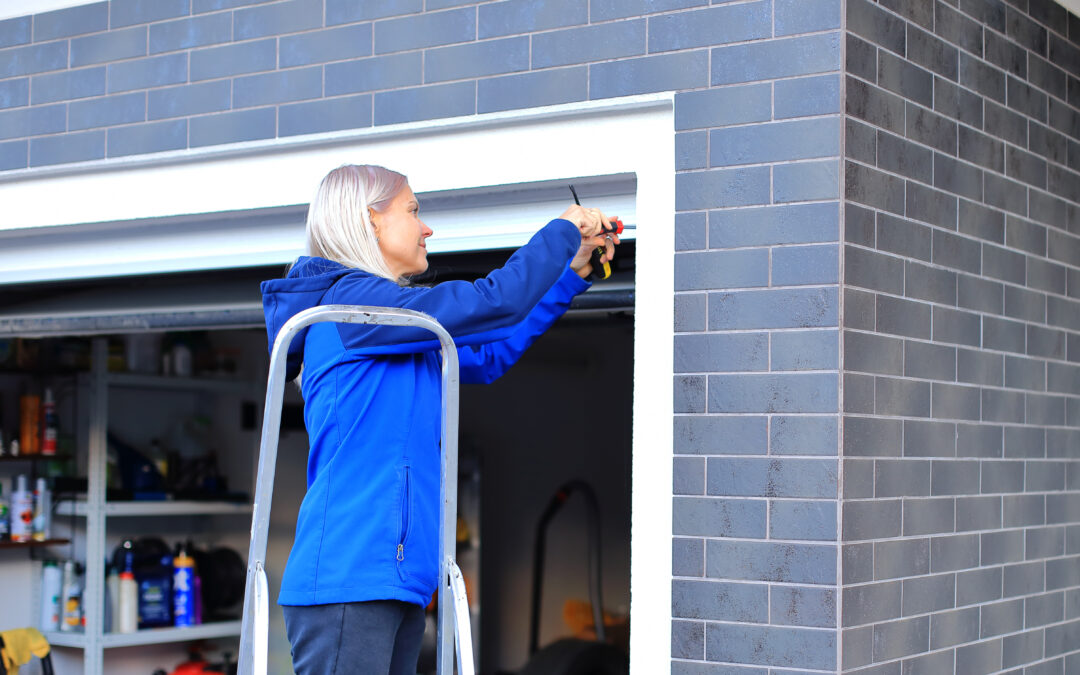
Bottom seals slide into a retaining channel on the bottom lath, so replacement is generally within reach of a competent DIYer. The typical process looks like this:
- Raise the door to a comfortable working height so the bottom lath is full accessible
- Remove the old seal by pulling it out of the retaining channel; on a wrap-around style seal this usually means unclipping it from the T-bar rather than sliding it out lengthways.
- Clean the channel to clear out any old rubber, dirt or debris that’s built up over the years.
- Measure and cut the new seal to the width of your door using a sharp utility knife.
- Fit the new seal into the channel, working along the full length, or clip it around the T-bar section if it’s a wrap-around type.
Exact fitting details vary by manufacturer and seal profile, since T-slot dimensions differ between brands, so it’s worth checking your door’s make before ordering a replacement rather than assuming a universal fit.
Side and Top Seals – A Simpler Retrofit
Side seals typically clip onto the vertical guide rail as a brush strip carried in a uPVC clip-on carrier, gripping the edge of the channel without needing screws or adhesive. Some installers add a compatible mastic sealant for extra security. Top seals across the head of the door usually follow the same clip-on brush principle, or use a self-adhesive foam or rubber strip that presses directly onto the frame.
Because these fit onto an external edge rather than into a load-bearing channel, they’re generally the easiest of the three seals for a homeowner to retrofit. They’re also a reasonable starting point if you’re sealing an older door that never had them.
DIY Draught-Proofing vs Professional Reseal – Where the Line Sits
Replacing a worn bottom, side or top seal with a like-for-like manufacturer part is a job most competent homeowners can do themselves with basic tools, and several UK seal suppliers design their products specifically for self-fitting. Where we’d recommend calling in a professional garage door installer instead:
- When the guide rails themselves are damaged or misaligned, since a new seal won’t compensate for a track that’s out of true.
- When the door is still under manufacturer warranty, as DIY work on some components can affect cover.
- When you can’t identify the exact seal profile for your door, since T-slot and channel dimensions vary between manufacturers and a poor-fitting seal won’t seal properly regardless of how well it’s fitted.
- When sealing is being done alongside other garage door repairs and maintenance, such as track lubrication or spring adjustment, where it’s more efficient to have one visit cover everything.
Sealing, Insulation and Your Energy Bills
Sealing and insulation do different jobs. Insulation determines how much heat passes directly through the curtain; sealing determines how much air bypasses the door altogether around its edges. A well-insulated garage door with poor seals will still lose significant heat, simply through the gaps rather than the curtain itself. The Energy Saving Trust notes that draught-proofing around doors, windows and floors can save a typical UK household in the region of £55 a year, and that draught-free homes feel comfortable at lower thermostat settings. Roller doors aren’t singled out in that guidance, but the principle holds: a poorly sealed door on an integral or attached garage is effectively a gap in your home’s thermal envelope.
Building Regulations rarely apply to a simple reseal. Part L sets thermal performance requirements for garage conversions and new builds, but for a standard existing roller door, sealing is treated as routine maintenance rather than a regulated requirement. Check current Part L guidance separately if you’re planning a conversion, since that involves thermal standards well beyond what sealing alone achieves.
Keeping Your Seals Working for Longer
A few simple habits extend the life of any roller door seal considerably.
- Clean the guide rails and bottom channel periodically, since grit and debris trapped against a seal accelerates wear and can prevent it seating properly.
- Lubricate the tracks as recommended by your manufacturer, since a door that’s dragging or binding puts extra strain on the seals as well as the mechanism.
- Check seals at the start of each season, particularly before winter, when a seal that’s marginal in summer can fail outright once temperatures drop and rubber stiffens.
- Avoid painting over rubber or brush seals, since this can cause them to harden and lose their flexibility much faster than normal wear would.
Conclusion
Keeping the bottom, side and top seals intact protects against water damage, keeps energy bills in check on an insulated door and stops the daily wear that comes from dust and grit working into the mechanism. Most replacements are within reach of a competent DIYer, provided you match the profile correctly; where the guide rails are damaged, the door’s under warranty or you’re unsure of the right part, it’s worth having it looked at professionally instead.
If your roller door needs new seals, a service, or you’re ready to replace it altogether, get in touch with our team at WM Garage Doors. We supply and install roller garage doors across the UK and can advise on the right seal or door for your home.
Aug 28, 2026 | Garage Door Comparisons, Garage Door Installation, Garage Door Types, Roller garage doors
A well-specified roller garage door is one of the most secure options on the UK market, but only when it’s built and locked properly. Double-skinned aluminium construction, automatic self-locking and police-accredited certification all make a real difference; a basic single-skin steel roller doesn’t offer the same protection.
This article covers how roller garage doors are built and locked, which UK security standards actually mean something, how they compare with sectional and up-and-over doors, the break-in methods they need to resist, and what we, from years of supplying and installing these doors, would recommend if security is your priority.
What Actually Makes a Roller Door Secure
Roller garage door security comes down to two things: the strength of the curtain (the rolling section of horizontal laths, or slats) and how it locks.
- Double-skinned aluminium laths, typically around 77mm deep with a CFC-free polyurethane foam core, give the curtain rigidity and resistance to being levered or punched through.
- Single-skin steel roller shutters are lighter and cheaper, but much easier to force. In our experience specifying doors for UK homes, this is the single biggest decision that separates a genuinely secure door from one that only looks the part.
- Reinforced end plates and a steel bottom lath add strength at the points most likely to be attacked.
- Deep guide channels (90mm on premium ranges) make it harder to lever the curtain out of its track.
Why the Best Roller Garage Doors Have No External Lock
Quality automatic roller garage doors lock themselves every time they close, either through anti-lift straps that engage as the curtain reaches the floor, or a self-locking gearbox motor that holds the curtain shut. There’s often no external lock cylinder at all, which means break-in attempts using picking, drilling and snapping simply have nothing to work on.
Hörmann describes this directly for its RollMatic range, stating the shaft profile makes it “practically impossible to push the curtain open.” SWS UK’s SeceuroGlide Excel goes a step further with a patented locking bottom slat that stops the curtain being pushed out of its guides.
Manual roller doors rely instead on a spring-assisted mechanism and a separate lock. From our experience on site, this is the real trade-off between manual and automatic doors: manual depends on the quality of a conventional lock, automatic depends on the motor holding firm and the emergency release being properly protected (more on that below).
Roller vs Sectional vs Up-and-Over Garage Doors: How Do They Compare on Security?
No garage door type is inherently insecure, but each one achieves security in a different way.
| Door type |
How it locks |
Typical weak point if poorly specified |
| Roller |
Auto-locking curtain or self-locking motor |
Single-skin steel build; unprotected emergency release |
| Sectional |
Multi-point track locking |
Panel joints on old or budget models |
| Up-and-over |
Traditionally one central locking bar; modern versions multi-point |
Older single-point bar; base vulnerable to lever attacks |
UK trade data shows roller and sectional garage doors scoring the same in LPCB’s LPS 1175 testing at SR1 and SR2, with no meaningful difference in real-world insurance claim rates between the two. Up-and-over doors with older single-point locking are the type most associated with a specific weakness, which is why aftermarket “garage defender” locks were designed specifically for them.
Specification matters more than door type, and that’s the main thing to take from our experience fitting all three. A well-built door of any of the three types resists forced entry; a poorly specified one doesn’t.
UK Garage Door Security Standards Worth Knowing
- Secured by Design (SBD) – UK police-backed accreditation; independently tested and certified. The clearest, most trustworthy security marker on the market. SBD-standard properties see 53% lower burglary and 77% lower attempted burglary (College of Policing).
- PAS 24 – British Standard test for resisting opportunistic forced entry; usual baseline before SBD.
- LPS 1175 – graded SR1 upwards by attack resistance and time; recognised by the ABI.
- STS 202 / STS 222 – Certisecure schedules, graded BR1 upwards, common on high-security roller doors.
- BS EN 13241 – a safety/performance standard, not a security certification.
Which Roller Garage Door Manufacturers Hold Genuine SBD Accreditation?
Not every “police approved” claim on a roller garage door checks out against the official SBD database. From our research, these roller door ranges hold verifiable accreditation:
- Hörmann RollMatic – STS 222/202 BR1 (fitted behind brickwork, no glazing, no external release)
- SWS SeceuroGlide Original and Excel – Excel also holds LPS 1175 SR1
- Gliderol insulated range – STS 202 Issue 6 BR1
- Aluroll Secureroll Classic – STS 202 Issue 7 BR1
- Novoferm Novorol 77 – STS 222 BR1, up to 3m wide
How Break-Ins on Roller Garage Doors Actually Happen
- Lifting/prying the curtain – countered by anti-lift geometry in the guide rail
- Forcing the bottom lath – countered by locking bottom slats and reinforced rails
- Attacking the guide rails – countered by deeper channels and reinforced slides
- “Fishing” the emergency release through a top gap – why SBD doors have no external release and no gap at the top
- Drilling/picking a lock – largely designed out on automatic doors with no external cylinder
What UK Burglary Data Shows
Recorded burglary in England and Wales fell to 245,284 offences in the year to March 2025 (ONS). Where offenders entered a dwelling, it was via a garage door around 70% of the time.
Smart Roller Doors and Remote Security
Rolling-code remotes, such as Hörmann’s BiSecur, generate a new encrypted code with every press from billions of possible combinations, defeating simple replay attacks. This should be standard on any new door.
Older fixed-code remotes send the same signal each time, making them easy to intercept with cheap equipment, and are now outdated technology worth upgrading away from.
More sophisticated attacks against rolling code do exist, such as the “RollJam” device demonstrated by security researcher Samy Kamkar, but these need proximity to the vehicle or door and specialist equipment. They’re worth knowing about rather than worrying over in a typical UK setting.
App and Wi-Fi control adds real convenience but also extends the risk to your home network, so it’s worth applying the same account hygiene you’d use for any other connected device.
Does a Secure Roller Door Affect Your Home Insurance?
Most UK insurers require evidence of forced entry through a locked door for a garage contents claim to succeed, and a padlock on its own may not always satisfy that requirement.
Garage and outbuilding cover limits also tend to sit well below main-house cover, with valuables frequently excluded altogether. The AA, for example, caps outbuilding theft cover at £3,000 on standard policies and £7,500 on its Plus tier.
No UK insurer currently advertises a specific premium discount for SBD-certified garage doors. It’s best to treat certification as proven protection and strong evidence to support a claim, rather than a guaranteed price cut, and it’s always worth checking directly with your insurer if this matters to you.
Improving an Existing Roller Door’s Security
- Upgrade the remote – Swapping a fixed-code handset for rolling code is a relatively small cost for a meaningful improvement.
- Check for gaps at the top of the door – This is exactly what emergency-release fishing attacks exploit, where a hooked wire is used to pull the release cord from outside.
- Add ground anchors or a garage defender – Sold Secure-rated devices give manual and up-and-over doors an extra physical layer.
- Secure the internal connecting door – The door between an integral garage and the house deserves the same standard as any external door, and is often overlooked.
- Keep the door maintained – Worn rollers and misaligned guides create the small gaps that make forced entry and cable-fishing easier.
Conclusion
For genuine garage door security, we’d specify double-skinned aluminium construction, automatic self-locking or a self-locking gearbox motor, no external manual release, deep guide channels and Secured by Design accreditation confirmed against the official database, with rolling-code remote technology as standard.
Door type matters less than most marketing suggests. What matters is whether the specific model has actually been built and tested to resist the ways burglars really try to get in.

Mar 2, 2026 | Garage Door Installation, News
WM Garage Doors is proud to announce that we were named finalist at the recent Hörmann Partner Standards Awards 2026, shortlisted for the highly regarded Installation Excellence award.
Being recognised by one of the leading garage door manufacturers in our industry is a significant achievement for our business. The Installation Excellence category celebrates quality workmanship and professionalism, which are values that sit at the heart of everything we do. To be acknowledged alongside other respected companies across the UK was a genuine honour and a milestone moment for our team.
While we did not take home the award on this occasion, being named as finalists reflects the hard work and skill of our entire team. Every garage door installation we complete is carried out with care and precision, and this recognition reinforces our ongoing commitment to delivering the highest standards for our customers.
We would also like to congratulate all of the winners and fellow finalists on their achievements. It was a privilege to be part of an evening that truly showcased the strength and professionalism of our industry.
This recognition has only strengthened our determination to continue raising the bar and providing installation excellence across the West Midlands and beyond.
